Fairies Tree by Ola Cohn
Fitzroy Gardens
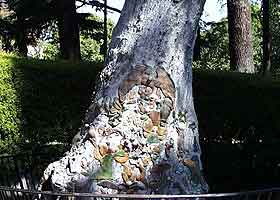
Completed in 1934, the 'Fairies Tree' is similar to a work in Kensington Gardens,
London. Hand-carved into an ancient red gum tree, the work features myriad carvings of Australian and European
fairies, dwarfs, gnomes, imps, goblins, elves and animals. Gifted to the city's children upon completion, the
'Fairies Tree' is a delight for all ages.
The Genie by Tom Bass
Queen Victoria Gardens
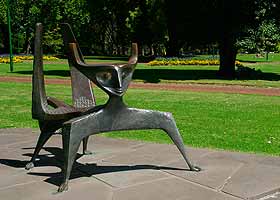
A wondrous play sculpture for children, 'The Genie' combines
the characteristics of an Egyptian cat with a lion and entices the imagination in fantastical ways. Nestled in
the Queen Victoria Gardens, children love exploring the sculpture and its fascinating textured surface. Photo by Louis Porter.
Miraggio by Pino Conte
Sidney Myer Music Bowl
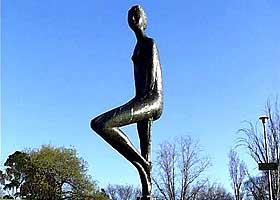
High on the slope of the Sidney Myer Music Bowl a young woman can be seen sitting
quietly, perhaps listening to music from the concert stage below. 'Mirragio' was donated to the city and the
Sidney Myer Music Bowl Trust by an anonymous Italian donor, with instructions that the figure be installed as
if she were part of the audience.
Model Tudor Village by Edgar Wilson
Fitzroy Gardens
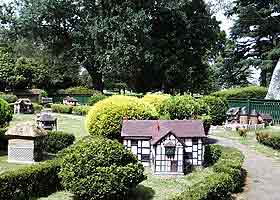
Where in Melbourne can you find the residences of
literary giant William Shakespeare and his wife Anne Hathaway? In the Model Tudor Village, of course. Donated
to What's on Melbourne in 1948 by then 77 year old artist Edgar Wilson, the Model Tudor Village has become a
much loved fixture of the Fitzroy Gardens, providing a representation of a typical Kentish village during the
English Tudor period.
The Pathfinder by John Edward Robinson
Queen Victoria Gardens
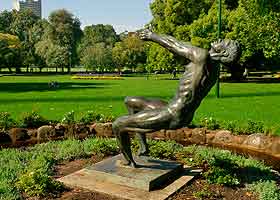
Commonly known as 'the hammer thrower', this athletic sculpture has been a city favourite since its unveiling in 1974. A once popular past-time for some Melburnians – stealing the hammer – means that, today the hammer is removed overnight and replaced again every morning. Photo by Louis Porter.
Reed Vessel by Virginia King
Docklands Park
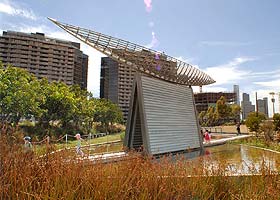
'Reed Vessel' is a filigreed and elevated
form embracing themes of migration, the journey and survival, the river and the sea. Referencing Docklands'
history and stories of the river and marine archaeology, the work emerges from the water, a visible
manifestation of the rebirth of Docklands. On the sides of the cradle, you'll uncover etchings, metaphors
about river and sea created by Australian poets and writers.